
You've published for years, but your best next idea may already be sitting in a folder you haven't opened lately. A podcaster has a long episode catalogue, a publisher has a crowded CMS, and a video team has interviews, captions, and unused footage scattered across drives. The challenge isn't always creating more. It's learning how to read the history of what you've already made.
Historical data analysis turns an archive into working material. Instead of treating old posts, episodes, and videos as finished objects, you examine them for themes, audience signals, gaps, and reusable evidence. The result can guide a new video, newsletter, course, campaign, or publishing decision without starting every project from an empty page.
Why Your Old Content Is About to Become Your Best Asset
A podcaster scrolls through years of episodes and remembers the work involved in producing each one. The interviews were researched, recorded, edited, and promoted. Yet the archive now feels like a storage problem. A publisher faces a similar frustration inside a CMS filled with evergreen articles, outdated explainers, transcripts, and drafts. Both teams have valuable material, but neither can easily answer a simple question: what deserves a second life?
Historical data analysis provides the answer by treating the archive as raw material rather than dead weight. An old interview might contain a useful explanation that was never turned into a short video. A transcript might reveal a recurring audience concern across several guests. A blog post might contain a foundational idea that could become a visual guide, a workshop, or a sequence of social posts.
Think of the archive as ore. The content itself is the rock, and historical data analysis is the refinery. It helps separate reusable insights from repetition, outdated context, and material that no longer fits your audience. You're not copying old work. You're identifying the parts that still carry meaning and adapting them for a new setting.
What the archive can produce
A disciplined review may uncover:
- New formats: Turn an interview into a newsletter, a video script, a carousel, or a lesson.
- Search opportunities: Find strong topics that deserve a clearer title, updated structure, or internal links.
- Editorial themes: Group separate conversations into a series or a larger point of view.
- Commercial material: Develop course modules, sponsorship packages, workshops, or premium research from proven knowledge.
- Audience questions: Locate subjects that appeared repeatedly but never received a complete answer.
This doesn't guarantee a viral revival or effortless revenue. It gives your team a stronger starting point. A practical content repurposing guide for small businesses can help translate that principle into a repeatable publishing habit, especially when your archive is growing faster than your production schedule.
The key shift is simple: old content isn't necessarily obsolete content. It may be poorly indexed, trapped in the wrong format, or separated from the context that would make it useful today. Analysis brings that buried value back into view.
What Historical Data Analysis Actually Means
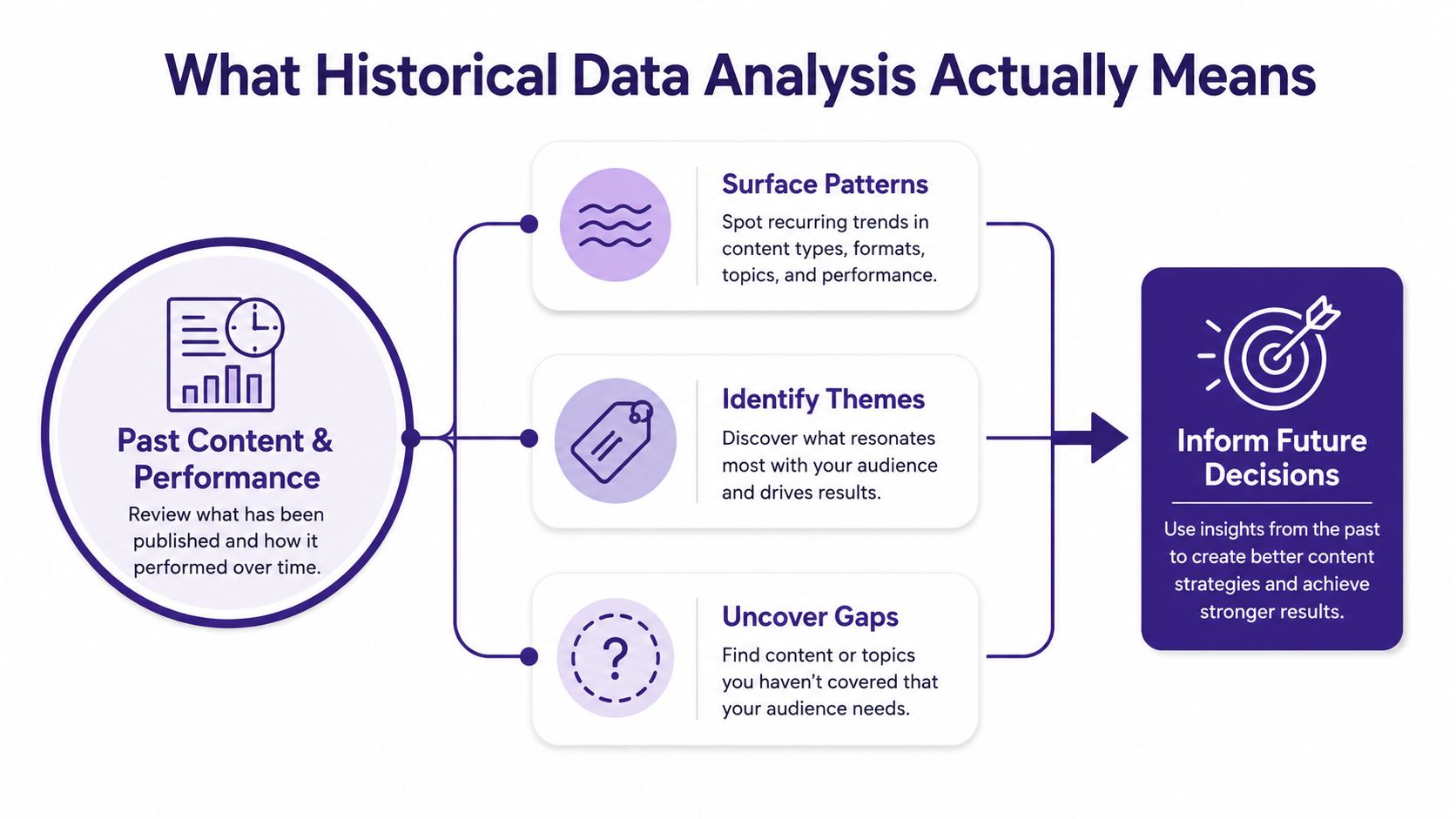
In creator language, historical data analysis means systematically examining past content and its performance signals to find patterns that can improve future decisions. You look at what you made, how audiences responded, what themes kept returning, and where your library has noticeable gaps.
Start with the inputs. Your archive may include:
- Text: Articles, books, newsletters, research notes, scripts, and drafts.
- Audio: Podcast files, interviews, voice notes, and transcripts.
- Video: Episodes, livestreams, captions, clips, and unused footage.
- Signals: Reach, retention, conversions, sentiment, citations, comments, and engagement patterns.
The output isn't just a dashboard. It might be a list of evergreen themes, a set of quotable moments, a recurring objection from customers, a cluster of related episodes, or a topic that appears important but has little coverage in your library.
A library card catalog with a search engine attached
A useful analogy is a library. A book collection becomes difficult to use when every title is stacked randomly. A card catalog adds structure by recording subjects, authors, dates, and locations. Archival taxonomy works similarly, using an intellectual hierarchy to make collections easier to find, as described by archival taxonomy and meta-tagging guidance.
Your modern archive needs that structure, but it also needs dynamic search. You should be able to ask, “Which interviews discussed pricing objections?” or “Where did we explain this concept for beginners?” and retrieve relevant material across formats.
Historical data analysis differs from competitive analysis because it begins with your own trail, not another organization's activity. It also differs from forecasting. Forecasting may use past data to estimate what happens next, while historical analysis first asks what the past contains and what conditions shaped it.
A working definition you can repeat to colleagues is this: historical data analysis is the organized examination of past content and its surrounding evidence to identify reusable knowledge, meaningful patterns, and missing context for better decisions. A searchable repository, such as the kind described in this overview of a centralized content library, gives that definition a practical home. If your archive includes marketplace or web data, a specialized e-commerce scraping pipeline may also help collect structured inputs before your team interprets them.
The Four-Stage Workflow That Turns Archives Into Insight
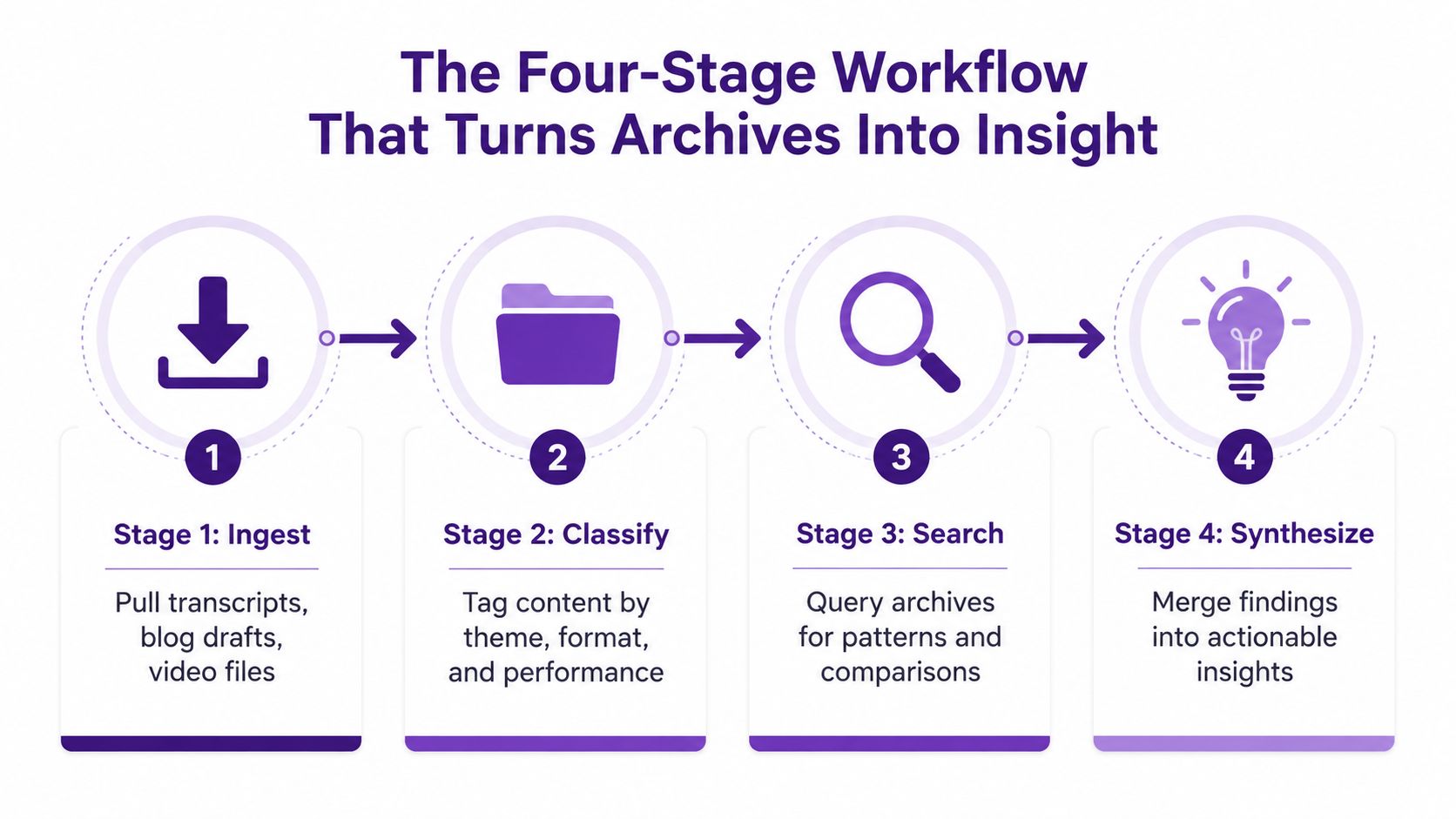
A useful workflow has four stages: ingest, classify, search, and synthesize. The stages are distinct, but the process isn't perfectly linear. A search may reveal missing metadata, and synthesis may show that your original categories were too broad.
Stage one, ingest
Bring the raw material into a searchable store. For a podcast team, that could include MP3 files, transcripts, episode descriptions, captions, guest notes, and engagement exports. For a publisher, it might include PDF manuscripts, blog drafts, images, page metadata, and update histories.
The point is not to collect everything indiscriminately. Record enough context to understand what each asset is, when it was produced, who created it, and where it appeared. A document without its date or source can be difficult to interpret later.
Stage two, classify
Add consistent tags for topic, format, audience, freshness, rights, and performance context. A B2B podcast might tag an episode as pricing, sales enablement, founder audience, interview, and evergreen. A publisher might use categories such as beginner guide, product comparison, policy update, or research feature.
Controlled vocabulary matters. If one editor uses “pricing strategy,” another uses “pricing,” and a third uses “commercial models,” your search will undercount the theme unless those labels relate to one another.
Stage three, search
Search with a decision in mind. Don't ask only, “What do we have?” Ask questions such as:
- Which episodes address the same customer problem?
- Which posts contain explanations that need updating?
- Which guests return to a theme from different angles?
- Which topics have strong source material but no short-form version?
A B2B podcaster might search for three episodes on pricing strategy, compare their arguments, and identify the clearest shared framework.
Stage four, synthesize
Turn the selected material into something useful. The three pricing episodes could become a pillar post, an email series, a workshop outline, and short clips. A publisher could transform an older explainer into a current video script after checking whether its terminology and evidence still hold.
Research programs that teach archival analysis commonly include tools such as OCR, PDF processing, and named entity recognition, as shown in this overview of analyzing archived data. Those capabilities become increasingly useful as your library expands. Teams looking to connect analysis with broader ideation can also review this guide to insight generation.
How Different Creators Use Historical Data Analysis
The same archive answers different questions depending on who is using it. A podcaster wants strong conversations and clips. A publisher wants durable pages and update priorities. A researcher wants intellectual continuity. A video team wants visual and verbal material that can be reshaped for new distribution.
| Creator Type | Primary Input | Typical Output | Key Metric |
|---|---|---|---|
| Podcasters | Episodes, transcripts, guest notes, listener responses | Evergreen episodes, clips, newsletters, topic series | Retention and repeat engagement |
| Publishers | Articles, drafts, citations, search data, update histories | Refreshed posts, pillar pages, explainers, new features | Search visibility and conversions |
| Researchers | Interviews, papers, field notes, recordings | Literature reviews, thematic maps, evidence summaries | Source coverage and analytical consistency |
| Video teams | Long interviews, footage, captions, B-roll | Shorts, trailers, compilations, scripts | Watch time and completion behavior |
Podcasters look for recurring conversations
A podcast archive often contains themes that become visible only across multiple guests. One guest may discuss pricing as a founder problem, another as a sales issue, and a third as a positioning challenge. Comparing those episodes can reveal a stronger editorial series than any single recording suggests.
Transcripts make this work faster because teams can search language rather than replay every minute. They can also locate quotable moments, identify repeated listener questions, and build a new episode around a theme that has already earned thoughtful treatment.
Publishers find update candidates
Publishers can use historical analysis to separate pages worth refreshing from pages that need a new angle. A post with strong foundational material may need current examples, clearer structure, and improved links. Another article may be too narrow to update but could supply a section for a larger pillar page.
The archive also reveals editorial blind spots. If several posts mention a topic without explaining it fully, that absence is a content opportunity. The aim isn't to publish more for its own sake. It's to make the existing knowledge easier to discover and more useful.
Researchers and video teams work with context
Researchers can trace how a concept changes across interviews, footage, and written records. That supports literature reviews and helps distinguish a genuine shift in thinking from a change in terminology.
Video teams work more spatially. They search for B-roll, visual motifs, memorable lines, and moments that can stand alone. A long interview can yield a short clip, a thematic compilation, and a fresh script, but each output requires a different editorial decision.
Pitfalls and Biases That Quietly Skew Your Results
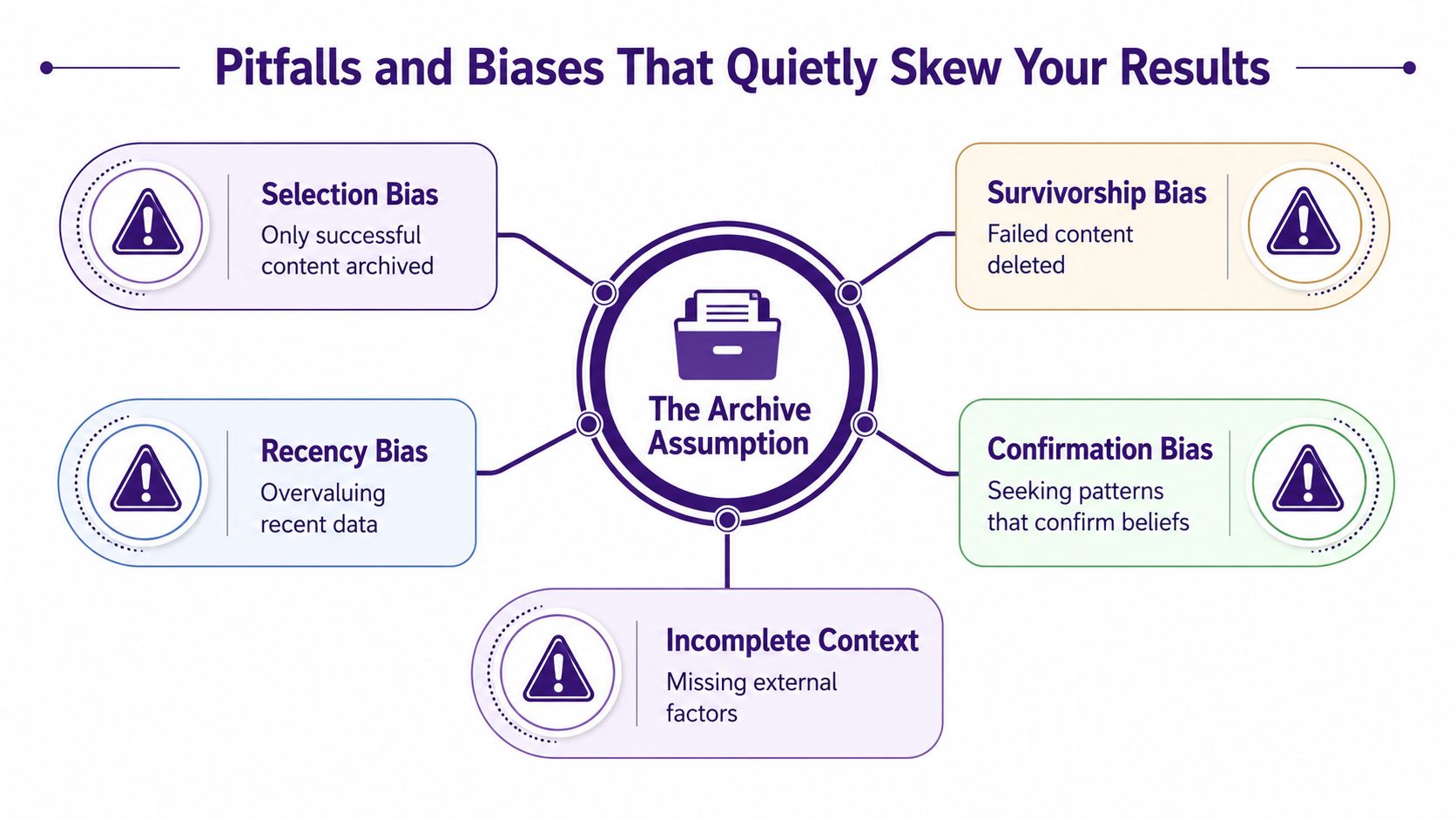
A larger archive doesn't automatically produce better insight. It can give you more opportunities to mistake incomplete records for a complete history.
Selection bias appears when only certain material was preserved. A team may have saved polished interviews but lost informal recordings, failed experiments, or early drafts. The archive then overstates the value of the formats that survived. Survivorship bias creates a similar problem when low-performing content is deleted, leaving only the pieces that looked successful.
Recency bias can push recent files to the top of a search and make older material seem less relevant. Confirmation bias is more personal. An editor who believes guest interviews perform best may search for evidence supporting that belief while overlooking formats that challenge it.
Missing periods are evidence problems
Platform migrations, broken links, changes in naming conventions, and inconsistent recording practices can create gaps. A missing month may represent a real pause, or it may show that the old system failed to export the records. You shouldn't fill that gap with invented continuity or assume the surrounding periods are comparable.
The same caution applies when taxonomies change. A topic labeled “remote work” in one period may have been filed under “distributed teams” earlier. Without a mapping between labels, the trend line reflects filing habits as much as audience interest.
Provenance protects the interpretation
For each asset, record who created it, when it was collected, how it was processed, and what changed afterward. Provenance guidance for archival and textual research emphasizes that lineage supports reproducibility, error tracing, authenticity checks, and correction when problems emerge.
Run these diagnostic questions before treating a result as authoritative:
- What's missing? Identify deleted files, unrecorded periods, unavailable platforms, and assets that were never digitized.
- What changed? Check shifts in audience, distribution, taxonomy, recording quality, publishing standards, and external events.
- Can we trace it? Confirm the source, date, author, transformation history, and version behind every important conclusion.
Historical datasets can reproduce older inequalities and collection gaps. A documented bias review, cohort-level checking, and comparison with contemporary reference material help prevent an old archive from becoming an unquestioned decision-maker. For a deeper treatment of interpretive safeguards, see this guide to analyzing qualitative data.
How AI Tools Like Contesimal Speed Up the Process
AI changes historical data analysis from a manual archaeological dig into a guided retrieval exercise. Automated transcription can turn audio into searchable text. Semantic tagging can connect related ideas even when creators used different words. Cross-archive search can surface relationships across podcasts, videos, articles, books, and research files.
A small team might once have spent three weeks replaying sixty podcast episodes to find recurring themes and usable quotations. With an indexed archive, the team can cluster episodes, search concepts, review candidate passages, and assemble a repurposing brief in an afternoon. That scenario illustrates a workflow change, not a guaranteed performance result. Human review still determines whether a quote is accurate, whether the surrounding context changes its meaning, and whether the proposed angle serves the audience.
Automation should remove friction, not judgment
AI is well suited to repetitive discovery tasks:
- Transcription: Convert spoken material into searchable text.
- Classification: Suggest tags for topics, formats, audiences, and themes.
- Clustering: Group assets that discuss similar ideas.
- Retrieval: Find passages, names, claims, and related files.
- Synthesis support: Draft outlines, briefs, and derivative-content options.
Contesimal is one example of a platform designed to organize and search historical libraries across documents, podcasts, videos, and articles while supporting collaboration between people and AI. Teams can use it to turn scattered source material into structured, searchable assets, then decide which findings deserve editorial action. For a broader category view, compare the workflow with content intelligence platforms.
The limits deserve equal attention. AI can misread a speaker, flatten disagreement, merge similar but distinct concepts, or recommend a pattern because it appears frequently rather than because it matters. Editors must validate citations, check permissions, preserve provenance, and reject convenient interpretations that the archive doesn't support.
Best Practices and a 2026 Outlook for Content Teams
A creator opens an old episode, finds a question the audience still asks, and discovers three unused angles in the surrounding research. That kind of result comes from treating an archive like a working library, not a storage room. Start with an inventory: formats, locations, dates, owners, permissions, and gaps.
Use a controlled vocabulary so related topics stay connected. Record each asset's provenance, then pair performance signals with listening notes. A number can show attention, while a transcript may explain what made the subject matter useful. Schedule recurring reviews, because a content library becomes more valuable as new results and context accumulate.
A practical checklist:
- Audit the archive: Identify what exists before drawing conclusions.
- Use consistent metadata: Tag topic, format, audience, rights, date, and status.
- Compare appropriate periods: Account for seasonality, platform changes, launches, and policy events.
- Question obvious patterns: Check whether a pattern reflects selection, deletion, or search ranking.
- Automate ingestion: Capture transcripts, captions, drafts, and performance records.
- Schedule synthesis sprints: Reserve time to turn findings into scripts, posts, courses, or campaigns.
- Share discoveries: Give editorial, marketing, research, and production teams the same evidence.
- Track external context: Preserve events that may have shaped performance.
- Review bias controls: Revisit representation gaps and collection assumptions.
- Protect rights and lineage: Store permissions and provenance with the asset.
A 2026 industry report projects that AI-driven and hybrid-cloud archiving could reduce storage costs by up to 80%, and that more than 75% of companies plan to implement AI in archiving processes by 2026. These remain projections, so teams should treat them as planning signals rather than established outcomes. An archive-focused dataset also preserves Google Trending Now history beyond its available seven-day window across 125 countries and 1,358 locations, helping analysts compare public interest across a longer record. Together, these examples show archives becoming searchable workspaces for finding formats, stories, and revenue opportunities.
Teams exploring data analytic strategies for high-growth teams should keep editorial judgment visible. By 2026 and beyond, multimodal search and AI-assisted synthesis may make audio and video easier to query, while context, permissions, and provenance still require human review. Historical data analysis gives the next decade of content a head start by showing which ideas can be adapted, expanded, or repackaged.
Contesimal helps creators, publishers, researchers, and content teams organize historical libraries, search documents and media, and turn proven knowledge into briefs, formats, and collaborative ideas. Visit Contesimal to see how an archive can support a next story, episode, course, or campaign.